The Costs of Inequality in Latin America by Sánchez-Ancochea Diego
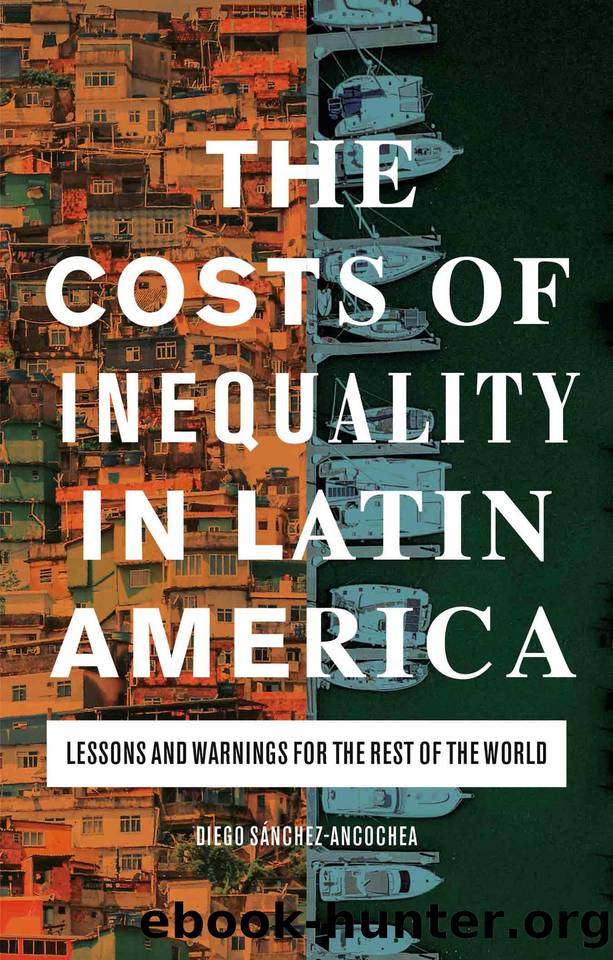
Author:Sánchez-Ancochea, Diego [Sánchez-Ancochea, Diego]
Language: eng
Format: epub
Publisher: Bloomsbury Publishing
Published: 2020-12-09T16:00:00+00:00
Latin America as a Hotbed of Ideas
I have taught a course on the economics of Latin America every year since the beginning of my academic career. One of my favorite classes is the one on â structuralist economics.â I love the fact thatâcontrary to mainstream economicsâ structuralism was proposed by Latin Americans to explain their own problems. Its success demonstrates the importance of developing indigenous ideas and policies. Yet its contemporary relevance goes beyond Latin America: many of its insights are useful to understand challenges in other parts of the world.
The initial structuralist ideas were proposed by the Argentinian economist Raúl Prebisch in the late 1940s. Born in Tucumán in 1901, Prebisch worked for the Argentinian government during the first stage of his career. He advised several ministers and co-founded the Argentinian Central Bank. During these years, he also became familiar with the work of John Maynard Keynes, the English economist who proposed a more active role for the state in economic management.
In 1949, Prebisch wrote a founding manifesto for the newly created CEPALâa United Nations regional institution based in Santiago (Chile). The 58-page paper placed Latin Americaâs problems in historical perspective, linked them to the regionâs place in the global economy, and proposed some policy solutions. The âLatin American manifestoâ became the inspiration for everyone working at CEPAL. 5
Structuralism developed a new way of thinking about the economy: more historical and more rooted in space than Anglo-Saxon economics. The lack of development in Latin America, Prebisch and his followers explain, resulted from its dependence on commodities and from its technological backwardness. Exporting mining and agricultural products was less advantageous than selling the kind of manufacturing goods produced in Europe and the US.
Structuralism provided a new interpretation of inequality. In their view, the only way to understand income distribution within each Latin American country was to consider the way the global economy was organized. Most technological innovations took place in countries like the UK, France, and the USâthe âcenterââand in many sectors simultaneously. These economies not only grew more but were also diversified and had many high- productivity sectors. Workers in all kinds of activities, from textiles to steam engines and from wine to steel-making, were highly productive and, as a result, relatively well paid. In contrast, countries in Latin America, Africa, and much of Asiaâthe âperipheryââwere specialized in agricultural and mining products and relied on innovations from abroad. In the periphery, many economic activitiesâparticularly within the manufacturing sectorâwere underdeveloped and most wealth was concentrated in the export sector. Most jobs were informal and poorly paid.
Here then is the main source of income inequality for structuralists: differences in productivity between various sectors, leading to large wage gaps. These differences generate a hierarchy of actors within any Latin American economy: at the top, the owners of the largest firms in leading sectors, and at the bottom, low-educated workers in subsistence agriculture and informal urban activities such as street vending. Unless countries diversify their economies, reduce the differences in productivity between sectors, and create more formal jobs, inequality will persist.
Download
This site does not store any files on its server. We only index and link to content provided by other sites. Please contact the content providers to delete copyright contents if any and email us, we'll remove relevant links or contents immediately.
| Anthropology | Archaeology |
| Philosophy | Politics & Government |
| Social Sciences | Sociology |
| Women's Studies |
The Secret History by Donna Tartt(19469)
The Social Justice Warrior Handbook by Lisa De Pasquale(12293)
Thirteen Reasons Why by Jay Asher(9118)
This Is How You Lose Her by Junot Diaz(7056)
Weapons of Math Destruction by Cathy O'Neil(6466)
Zero to One by Peter Thiel(5951)
Beartown by Fredrik Backman(5937)
The Myth of the Strong Leader by Archie Brown(5623)
The Fire Next Time by James Baldwin(5582)
How Democracies Die by Steven Levitsky & Daniel Ziblatt(5322)
Promise Me, Dad by Joe Biden(5229)
Stone's Rules by Roger Stone(5189)
A Higher Loyalty: Truth, Lies, and Leadership by James Comey(5087)
100 Deadly Skills by Clint Emerson(5023)
Rise and Kill First by Ronen Bergman(4890)
Secrecy World by Jake Bernstein(4878)
The David Icke Guide to the Global Conspiracy (and how to end it) by David Icke(4850)
The Doomsday Machine by Daniel Ellsberg(4619)
The Farm by Tom Rob Smith(4611)
